
Sunday, October 27, 2013
The Bermuda Triangle of Triangle Problems
Here is a good puzzler: How many triangles can you get from this picture? Something like 93% get it wrong! Have fun...

Wednesday, October 23, 2013
Gravitational energy the Right Way
Check out this video in class. Take notes on it, and you will need it for the exercise that follows for a rocket launch to the moon.
Tuesday, October 15, 2013
Example of Excel Solver
Ms. Fitzpatrick has led us through an example of using Excel Solver to do optimization problems, and a set of instructions for this can be found here. Note that I have a folder with a number of helpful resources for our open-ended project (the bus problem), as well as contests like COMAP and Moody's, in Shared Documents on my school website.
Here is another example via video on how to use Solver, in case it is helpful.
Here is another example via video on how to use Solver, in case it is helpful.
Monday, October 7, 2013
Nobel Prizes 2013
The Nobel Prizes for 2013 are being announced this week. First up, two Americans and a German share the prize for medicine and physiology, for their work in understanding the transport system in cells. Check out the press release from the Nobel committee.
The Nobel for physics is not much of a surprise, with Peter Higgs (UK) and Francois Englert (Belgium) winning for their work on symmetry breaking and the Higgs field/boson that was confirmed at CERN over the past year. Check out the press release from the Nobel committee. This one is especially cool for me since many former colleagues and friends from Fermilab, and two former students, are on the experiments that discovered the Higgs boson!!
The Nobel for chemistry was given to Martin Karplus (Harvard), Michael Levitt (Stanford), and Arieh Warshel (UCLA) for their work in developing computer simulations of chemical reactions. These powerful simulations allow scientists to not just see what the end products are, but also predict and understand at timy time steps what actually happens during chemical reactions. This work includes both Newton's laws as well as quantum mechanics. Check out the press release.
The Nobel Peace Prize for 2013 was given to the Organization for the Prohibition of Chemical Weapons. Most recently, this group is going to play a key role in Syria, as the U.S. is leading he charge to eliminate chemical weapons from their weapons stockpiles. See the press release from the Nobel committee.
Monday, September 30, 2013
PhET Simulation for the Pendulum Lab
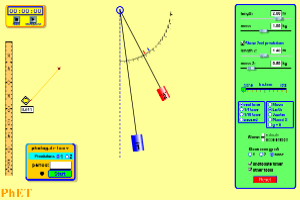
We are unable to vary the strength of gravity in the lab, so the way we can do this is to use a computer simulation. Check out the PhET Physics Simulations, and in particular the Pendulum simulation. When running the simulation, focus on the gravity portion, where you can vary it using earth, moon, Jupiter, and no gravity. Use the measuring tools to measure the period for each gravity setting, and you will use these data points to plot period (y-axis) vs. g (x-axis) in Excel, to get a best fit function. Click on the image below to launch the simulation from here.
Some useful data: Earth g = 9.8 m/s^2; Jupiter g = 24.8 m/s^2; Moon g = 1.6 m/s^2.
Some useful data: Earth g = 9.8 m/s^2; Jupiter g = 24.8 m/s^2; Moon g = 1.6 m/s^2.
Thursday, September 19, 2013
Cutting-edge Nanoscale Research of Friction
Scientists have studied friction for centuries, and yet there is still so much we do not understand about it because the origin of friction is at the molecular level. Check out this article for a summary of recent research done at the nanoscale, as scientists are learning about what happens with individual atoms involved with friction forces.
How Could I not Put This On?! Learn String Theory via Bohemian Rhapsody!
This is simply an amazing song and video - I have to think you will enjoy it! Learn string theory from a Master's student, who puts it down via Queen's Bohemian Rhapsody. Enjoy!
Wednesday, September 11, 2013
Checking Out Electric Charge and E-Fields
As we begin Electricity and Magnetism, we want to investigate properties of electric charges and the electric fields they create at all points in space around the charge. Before we formally spell out the properties of charge and the standard interpretations of those properties, it is more fun and educational for you to 'discover' the properties on your own if at all possible. We will try a PhET simulation for you to use, and you can perform computer experiments to try and figure out some features of charges and fields based on your observations.
When using the 'Electric Field of Dreams' simulation, you can add electric charges with the Add button, and with properties play with adding both negative and positive charges. By clicking on the Electric Field option at the top of the simulation window, you can set the E-field discreteness, which adds more field arrows to help you easily see what the fields look like from each charge. Try to observe so you can answer the following questions:
- In which direction do the electric field vectors point for a positive charge? For a negative charge?
- What direction does an External electric field push a negative charge? A positive charge?
- What determines how strong the electric force is between two charged particles?
Record your observations and answers to the above questions in your lab book. There is also an ActivPhysics simulation you should open and run. It is about the electric fields from point charges (number 11.4, Electric Field: Point Charges). Work through the lesson, using the simulations to make observations and to answer questions presented in the lesson. Also take advantage of the Advisor option in ActivPhysics, so you can compare your thoughts with the correct responses. This will provide a nice 'second opinion' to the PhET simulation. Again, focus on observations of E-field and force vectors relative to positive and negative charges. You want to try to convince yourself of how this all works based on your observations and not so much on Doc V in class! :-)
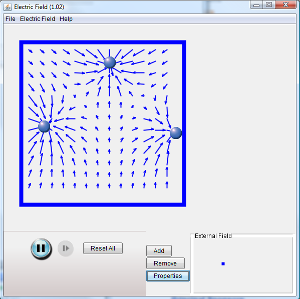
When using the 'Electric Field of Dreams' simulation, you can add electric charges with the Add button, and with properties play with adding both negative and positive charges. By clicking on the Electric Field option at the top of the simulation window, you can set the E-field discreteness, which adds more field arrows to help you easily see what the fields look like from each charge. Try to observe so you can answer the following questions:
- In which direction do the electric field vectors point for a positive charge? For a negative charge?
- What direction does an External electric field push a negative charge? A positive charge?
- What determines how strong the electric force is between two charged particles?
Record your observations and answers to the above questions in your lab book. There is also an ActivPhysics simulation you should open and run. It is about the electric fields from point charges (number 11.4, Electric Field: Point Charges). Work through the lesson, using the simulations to make observations and to answer questions presented in the lesson. Also take advantage of the Advisor option in ActivPhysics, so you can compare your thoughts with the correct responses. This will provide a nice 'second opinion' to the PhET simulation. Again, focus on observations of E-field and force vectors relative to positive and negative charges. You want to try to convince yourself of how this all works based on your observations and not so much on Doc V in class! :-)
| Click to Run |
Thursday, September 5, 2013
Open-Ended Problems Resources
We have a team challenge, involving the development of an environmentally friendly bus fleet for a school district. This is a real-world, open-ended problem with different approaches that can be taken, and no single 'right' answer! Complex problems hound us in all fields in real life, so being able to attack such problems and develop reasonable solutions is a skill set that is necessary in the 21st century. You are going to have to collaborate, do research to find reliable resources of large data sets, use technology to assist the process, communicate your work, use more advanced thinking and problem solving skills (such as developing a mathematical model), make predictions that can be tested against a real world sample, develop creative solutions, and so on!
To assist you, here are various resources that will hopefully be helpful for you and your team:
Check out other open-ended, complex problems from the COMAP High School Mathematical Modeling Contest (HiMCM) and the Moody's Mega Math Challenge. The home pages are: HiMCM and Moody's.
Problems from past contests are: HiMCM and Moody's.
Exemplar papers from Moody's. This includes an ETHS team paper that took 5th place nationally!!! See what a good paper looks like. See how teams took a problem and broke it down into simpler pieces, and what assumptions they made. See how a mathematical model was developed, and what math techniques went into the model's development. See how they explained their work. See how they used the model to make predictions that could be tested against real data and other information. See how they determined and explained the weaknesses of the model. Might as well learn from some others who did a good job with this process!
Judge's perspectives from Moody's can be found on this page, and for COMAP on this page (pages 17-35). These are especially useful because they point out what makes for an average solution paper compared to an outstanding solution paper! Are you doing these things for your solution paper? If not, why not? How can you re-adjust and make the solution better? If you had more time, what would you focus on to try and improve your solution proposal?
Teams might consider drawing out a flow chart early on in the process that outlines key components and assumptions you want to make. Get a visual picture of what this all looks like, and think about what is connected to what. Do you expect direct or inverse relationships? Linear or non-linear? What factor or parameter, when changed, will have an effect on other parts of the model/solution?
We hope these all help you in this process. Good luck, and have fun with it!
Effective Effort and Growth Mindset
Here is a video we will discuss, and I hope you will think about at least a little. It addresses some thoughts and ideas, largely from the field of psychology and the work of Carol Dweck, called effective effort and mindset. Dweck proposes the notion that there are two main mindsets (in her book entitled Mindset) that are really important in education: fixed versus growth mindsets.
Over the past decade or two, scientists have learned much about the brain and how we learn. The brain is malleable, meaning it can change throughout life. Even with age, the brain can still grow, change, and form new synapses. One can get smarter. Intelligence is NOT fixed at birth, and those who buy into this incorrect notion and feel they are restricted naturally from getting smarter or doing better in school are in a fixed mindset. Those who understand they really can improve with effort, and that their brains can grow and their intelligence is not fixed are in the growth mindset. Dweck has seen in her studies significant differences between the success of fixed and growth mindset students (of all ages, gender, races and ethnicities, etc.).
Think of a student in a fixed mindset. If intelligence is fixed, and your potential and abilities are therefore limited in learning, then why would one want to expend extra effort and energy into trying to learn something a second or more times? Why try if it is pointless? Some students in this mindset also view extra effort as a sign of low intelligence, because you either have it or you don't, and it is dumb to try if you don't have the intelligence.
A student in a growth mindset takes the approach that additional effort is wonderful! Working harder and taking on continuous intellectual challenges is cool! The reason is no different than in something like basketball - if you want to get better at shooting free throws, what do you do? You try more free throws. You work on your strength so it is easier to shoot. You train your muscles to do the task. A growth mindset identifies how the brain really works - it is like a muscle, and you can train it, by mental exercise, to do the task you want! That is really neat!!
Check this video out, and think about it. More importantly, think about your own approach. Check out some of the science behind the claim the brain can grow, that one can become smarter by training the brain.
Subscribe to:
Posts (Atom)