Monday, May 26, 2014
CONGRATULATIONS, Seniors! You will be missed!
Another year, another WONDERFUL group of young men and women who have completed ETHS and are moving on to college, gap years, and amazing lives! You will be missed, but also I couldn't be happier for you as you enter the next major phase of your young lives. Enjoy it all, college is one of the best times in life, and make the most of your opportunities and many gifts and talents. Try to make the world just a bit better!

Wednesday, May 21, 2014
Check out an Interview with Prof. Melissa Franklin, first tenured female physics prof at Harvard
Here is an interview with Melissa Franklin, the first female professor of physics to receive tenure from Harvard back in 1992. She was a colleague at Fermilab, back in the days of the top quark discovery. She is an interesting person!
Monday, May 12, 2014
New Report on West Antarctica Ice Shelf - Collapse "Unstoppable"
Scientists have long feared and warned the world about the collapse of enormous glaciers and ice shelves on the western side of Antarctica, and new satellite and radar data analyses confirm some worst fears - it is melting at rates that exceed predictions, and within a couple centuries (incredibly short in geologic time) oceans would rise several feet. The video below has a brief summary of what measurements are suggesting.
Sunday, May 4, 2014
Maxwell's Equations and EM Waves
This is the portion of the Caltech series, Mechanical Universe, that shows what the four Maxwell equations are! It is very well done.
The KEY IDEAS you need to remember is that, in electromagnetism, when a magnetic field changes through an area, i.e. a change in magnetic flux, then an electric field is induced that is perpendicular to the magnetic field (such as a circulation). But with the Maxwell displacement current, when there is a changing electric field and flux, a magnetic field is induced! These induction processes are what creates electromagnetic fields in space!!
So if we have AdB/dt, an E-field is induced.
If we have AdE/dt, a B-field is induced.
The KEY IDEAS you need to remember is that, in electromagnetism, when a magnetic field changes through an area, i.e. a change in magnetic flux, then an electric field is induced that is perpendicular to the magnetic field (such as a circulation). But with the Maxwell displacement current, when there is a changing electric field and flux, a magnetic field is induced! These induction processes are what creates electromagnetic fields in space!!
So if we have AdB/dt, an E-field is induced.
If we have AdE/dt, a B-field is induced.
Maxwell's Displacement Current - How Capacitor Circuits Work
Many students have a difficult time understanding capacitors...I certainly did. How in the world can a circuit with a cut wire, where the capacitor is, have current flow? If you actually cut a wire in any other circuit the current dies! What is different about a capacitor?
The answer lies in the fact that a capacitor has a large area where charge stores, and therefore has an electric field that flows across the gap. You don't get this with the two ends of a cut wire. So there is something special about that electric field. Remember, there physically is no current flowing across the gap, only the electric field.
James Clerk Maxwell figured out the details back in the mid 1800s. This video will explain the details of what Maxwell discovered. He showed that, since it takes some time for a capacitor to charge up (think of our RC circuit derivations) or discharge, then the E-field is time dependent - it changes. This means there is a change in electric flux across the gap of a capacitor. Now, he knew Faraday's law said that when there is a changing magnetic field, then a circulating electric field is induced. Does it make sense that if an electric field changes a circulating magnetic field should be induced? Where have we seen circulating magnetic fields before? These are produced with electric currents in straight wires! This is Ampere's law. Could the changing electric flux of a capacitor act like a current in a wire? We call this the displacement current.
Turns out, YES! Check it out.
The answer lies in the fact that a capacitor has a large area where charge stores, and therefore has an electric field that flows across the gap. You don't get this with the two ends of a cut wire. So there is something special about that electric field. Remember, there physically is no current flowing across the gap, only the electric field.
James Clerk Maxwell figured out the details back in the mid 1800s. This video will explain the details of what Maxwell discovered. He showed that, since it takes some time for a capacitor to charge up (think of our RC circuit derivations) or discharge, then the E-field is time dependent - it changes. This means there is a change in electric flux across the gap of a capacitor. Now, he knew Faraday's law said that when there is a changing magnetic field, then a circulating electric field is induced. Does it make sense that if an electric field changes a circulating magnetic field should be induced? Where have we seen circulating magnetic fields before? These are produced with electric currents in straight wires! This is Ampere's law. Could the changing electric flux of a capacitor act like a current in a wire? We call this the displacement current.
Turns out, YES! Check it out.
Saturday, April 19, 2014
How to use the Chain Rule for Derivatives
Every so often in physics we come across a slightly more complex function for a problem than what we are used to, and then need to find a derivative of that more complex function. By more complex I am referring to the case of 'compound functions,' which I define as an outside function operating on an inside function. A classic example happens with our solution to simple harmonic motion problems, where the position of a mass on a spring is defined as x(t) = Asin(wt + phi) or Acos(wt + phi), where A is amplitude, w is the angular frequency, and phi is a phase angle; these three are just constants. Here, we have an 'outside' function, sine or cosine, operating on an inside function, (wt + phi). How would you find the derivative of this compound function, which is necessary in physics if we want to find velocity and acceleration?
The answer is the Chain Rule. This says: the derivative is just the derivative of the outside function times the derivative of the inside function.
Check out a few examples in this video, and I suspect you will catch on within a few minutes. I hope this helps.
The answer is the Chain Rule. This says: the derivative is just the derivative of the outside function times the derivative of the inside function.
Check out a few examples in this video, and I suspect you will catch on within a few minutes. I hope this helps.
Friday, April 18, 2014
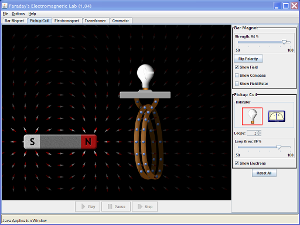
EM Induction Simulations: PhET
For visuals on EM Induction applications and contraptions, try this PhET simulation. You will get a sense of some induction properties and characteristics, so you have some good pictures in your heads as you do the mathematical details of these phenomena.
How to do the "Hardest Induction Problem Ever!"
I've given a problem to my students in E&M as a challenge problem - I call it the "hardest problem ever." It is a Faraday's law problem, where we have a circuit made of a bar sliding down a frictionless hill inside a constant magnetic field. This is the type of problem where the emf = -B dA/dt.
First, recognize that any problem where the area changes has the same answer for the emf: emf = Blv. This will be the case once again, as shown in the video. The challenging part of this is that, on a hill, there is a gravity component. There is also, in every type of problem like this where the area changes, a magnetic braking force (this tries to slow down the change in flux, and fits in with Lenz's law). If the magnetic braking force is the only force, it will slow the bar exponentially, like air friction on a hockey puck. But here, when there is a constant force trying to speed it up in addition to the magnetic braking force, we have a behavior like a sky diver - a terminal speed is reached!
Check out the details and see if it makes any sense.
First, recognize that any problem where the area changes has the same answer for the emf: emf = Blv. This will be the case once again, as shown in the video. The challenging part of this is that, on a hill, there is a gravity component. There is also, in every type of problem like this where the area changes, a magnetic braking force (this tries to slow down the change in flux, and fits in with Lenz's law). If the magnetic braking force is the only force, it will slow the bar exponentially, like air friction on a hockey puck. But here, when there is a constant force trying to speed it up in addition to the magnetic braking force, we have a behavior like a sky diver - a terminal speed is reached!
Check out the details and see if it makes any sense.
Tour of Doc V's Web Pages: School Page and Class Blog
This video is a bit different than the others - I simply want to make sure you know all the resources available to you on my class site on the school website, and what the most important pages on my class blog are. Check it out so you don't miss out on information that may be useful for you. And most importantly, if there are favorite sites of yours that you ever want to share with your classmates, just let me know the link and I'll get it on the site or blog. I hope this helps!
Sunday, April 13, 2014
How to do Biot-Savart for Multiple Currents - Yikes!!
Here it is...this can be for many students, the toughest part of magnetism. Biot-Savart (B-S) integrals for currents. Keep in mind B-S is the general law for finding magnetic fields from moving charges, and when there is a current, i.e. many moving charges, we need to add up a bunch of small B-fields to get the total - that means an integral!
Check out this video as an example for two currents. This means two magnetic fields, and therefore two integrals. Replay it as necessary, try to work along with it, to get the hang of constructing the integrals needed for a specific problem. Typically the thing that changes from problem to problem is the location of the point we are looking at, so that changes the bounds on the integrals. But the construction is pretty much the same process every time. FOCUS ON THE PROCESS used to construct each of the integrals, and that will help...that is the physics. I'm not even going to show the solutions of the integrals, because that is math; learn the physics here!
Check out this video as an example for two currents. This means two magnetic fields, and therefore two integrals. Replay it as necessary, try to work along with it, to get the hang of constructing the integrals needed for a specific problem. Typically the thing that changes from problem to problem is the location of the point we are looking at, so that changes the bounds on the integrals. But the construction is pretty much the same process every time. FOCUS ON THE PROCESS used to construct each of the integrals, and that will help...that is the physics. I'm not even going to show the solutions of the integrals, because that is math; learn the physics here!
Subscribe to:
Posts (Atom)