For periods 1-2 and 8-9, check out and take notes on angular momentum conservation in collisions involving rotations. One of the videos gives two examples of conservation of angular momentum: click here. A second video is similar to a ballistic pendulum: click here. From our angular momentum packet, try page 3 1981; page 6; page 7 2005.
For periods 3-4, check out two videos on circuits involving inductors. Keep in mind, these are, mathematically, at least, similar to RC circuits. Take notes on each video. The first is when things are in series: click here. The second is when an inductor and resistor are in parallel: click here. From the new inductor packet, try page 2 2005; page 5 1991; and page page 6.
Monday, March 30, 2015

Saturday, March 21, 2015
EM Induction Check List
Check out the check list:
EM Induction Check List
-
Can you define magnetic flux?
-
Can you define induction (in general)?
-
Can you define emf?
-
Do you know what Faraday’s law is
mathematically?
-
Do you know the two main ways of changing
magnetic flux?
-
Do you know why the – sign is placed in Faraday’s
law?
-
Can you state Lenz’s law?
-
Can you apply Lenz’s law for increasing flux?
Decreasing flux?
-
Do you know what happens to a conducting rod
moving in a B-field?
-
Can you find the E-field strength in a moving
conducting rod in a B-field?
-
Can you explain why a current turns on when the
area is changing (i.e. the loop/circuit is moving)?
-
Can you explain why a current turns on when a
B-field is changing (i.e. dB/dt)?
-
Can you find emf, current, IL x B forces, v(t),
power, and heat energy when the loop/circuit is moving and the area is
changing?
-
Can you find emf, current, IL x B forces, power,
heat energy, and the induced circulating E-field when there is dB/dt?
-
Do you know what an inductor is?
-
Do you know what an inductor does in a circuit?
And why?
-
Do you know how to find the energy stored in an
inductor?
-
Can you derive i(t) in a series LR circuit?
-
Can you figure out the currents in a LR circuit
when L and R are in parallel?
-
Do you know what happens when there is a LC
circuit?
-
Can you determine a solution for q(t), i(t),
di/dt in a LC circuit?
-
Can you find the frequency of oscillation of
current in a LC circuit?
-
Can you explain, at least qualitatively, what resistance
does in a LRC circuit, compared to an ideal LC circuit?
-
Can you explain the gist of how a radio works
(or wireless technology in general), in terms of LC circuits?
-
Can you explain what the Maxwell displacement
current is?
-
Do you know what the four Maxwell equations are?
-
Can you qualitatively explain how you can create
an electromagnetic wave?
-
Do you know what a transformer is, and how it
works?
-
Can you explain how various contraptions work in
terms of em induction (think of all the devices in our lab)?
Friday, March 20, 2015
EM Induction Videos
Here are links to the videos relevant to EM Induction.
Here is a magnetic flux example, where a circuit is next to a long wire.
The simplest case of induction is just a conducting bar moving through a B-field. The B-field will polarize the rod, due to F = qv x B. To spice it up, you can rotate the bar in a B-field.
For Faraday's law of induction, the version emf = -B dA/dt.
For Faraday's law of induction, the version emf = -A dB/dt. Also with this version of Faraday's law is how to find the circulating electric fields that are induced when we have dB/dt.
Here's an example of a circuit falling through a B-field, and the magnetic braking force can lead to a terminal speed.
When we put solenoids in circuits, they are called inductors. Here's a series LR circuit.
Here is a LR circuit with the inductor and resistor in parallel with each other.
The last circuit we do is an LC circuit (inductor and capacitor in series with each other).
Finally, here is one about Maxwell's displacement current, which he needed to explain how capacitors really work and to complete Ampere's law.
Here is a magnetic flux example, where a circuit is next to a long wire.
The simplest case of induction is just a conducting bar moving through a B-field. The B-field will polarize the rod, due to F = qv x B. To spice it up, you can rotate the bar in a B-field.
For Faraday's law of induction, the version emf = -B dA/dt.
For Faraday's law of induction, the version emf = -A dB/dt. Also with this version of Faraday's law is how to find the circulating electric fields that are induced when we have dB/dt.
Here's an example of a circuit falling through a B-field, and the magnetic braking force can lead to a terminal speed.
When we put solenoids in circuits, they are called inductors. Here's a series LR circuit.
Here is a LR circuit with the inductor and resistor in parallel with each other.
The last circuit we do is an LC circuit (inductor and capacitor in series with each other).
Finally, here is one about Maxwell's displacement current, which he needed to explain how capacitors really work and to complete Ampere's law.
Wednesday, March 18, 2015
For Classes, March 19, 2015
Periods 1-2, 8-9:
Watch and take notes on the two videos for so-called RL circuits. These are circuits that have an inductor, which is basically a solenoid, with a resistor. The symbol L stands for inductance, and it has a unit called a Henry (H). Yes, another name!
One thing that stands out as you watch these is the math analysis - it should look like RC circuits.
Check out the video on RL circuits in series.
Then, check out the video on RL circuits where things are in parallel.
When done with the videos, try to work your way through the problem set for tomorrow. On Friday, we will get into the combination of inductors with capacitors, and some interesting effects will take place!
Watch and take notes on the two videos for so-called RL circuits. These are circuits that have an inductor, which is basically a solenoid, with a resistor. The symbol L stands for inductance, and it has a unit called a Henry (H). Yes, another name!
One thing that stands out as you watch these is the math analysis - it should look like RC circuits.
Check out the video on RL circuits in series.
Then, check out the video on RL circuits where things are in parallel.
When done with the videos, try to work your way through the problem set for tomorrow. On Friday, we will get into the combination of inductors with capacitors, and some interesting effects will take place!
Monday, March 16, 2015
Another Confirmation of Einstein's Theories
A high precision, experimental confirmation that photons of varying frequencies/energies has been made from an analysis of radiation from a gamma ray burst. Check out an article here. Photons of a range of energies, that traveled billions of years to the earth, arrived within a tiny fraction of a second of each other. This is as Einstein predicted almost exactly 100 years ago, when his theory of general relativity was published in 1915. This measurement also restricts the notion of 'quantum foam" that is predicted from a variety of theories attempting to unify relativity with quantum mechanics. If quantum foam (basically think of space as being quantized, and not continuous) exists, then photons with different energies should be affected by different amounts, and the photons should not have arrived all together. This is published in Nature Physics.
Friday, March 13, 2015
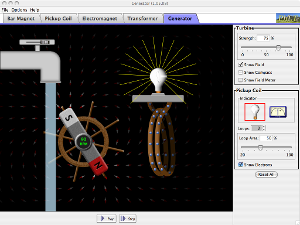
PhET Simulations for EM Induction
Here is the set of simulations for our EM Induction computer lab. Or, you can click here to go to the PhET site.
Wednesday, February 18, 2015
Magnetism stuff
For our magnetism quizzam, how well do you know:
- where magnetism comes from
- magnetic domain concept
- magnetic forces on charges, current carrying wires
- cross products, RHR vs LHR, circular motion of particles
- velocity selector, mass spectrometer
- force between multiple wires
- Ampere's law (long wires, long cylinders, toroids)
- Biot-Savart law (point charges, straight wires, current loops)
- current densities and Ampere's law (uniform, NON-uniform)
- Hall effect concept
This post has quick links to a bunch of magnetism videos. There are good simulations on ActivPhysics, and lots of good examples in the book, old AP exams, Princeton Review, etc.
- where magnetism comes from
- magnetic domain concept
- magnetic forces on charges, current carrying wires
- cross products, RHR vs LHR, circular motion of particles
- velocity selector, mass spectrometer
- force between multiple wires
- Ampere's law (long wires, long cylinders, toroids)
- Biot-Savart law (point charges, straight wires, current loops)
- current densities and Ampere's law (uniform, NON-uniform)
- Hall effect concept
This post has quick links to a bunch of magnetism videos. There are good simulations on ActivPhysics, and lots of good examples in the book, old AP exams, Princeton Review, etc.
Monday, February 16, 2015
Ampere's law with NON-Uniform Current Density
Here is an example of how to do a worst case scenario with Ampere's law (for a long, straight wire): A NON-uniform current density flowing through the cross sectional area of the wire.
Current density is just the current / (cross sectional area the current flows through). If this flow is a function of the radius, then it is NON-uniform flow, and, like a non-uniform charge density for Gauss's law, we will need to integrate the current density function to find the current inside the region we want. It hopefully sounds worse than it is, so check out the video for an example. I hope it helps!
Current density is just the current / (cross sectional area the current flows through). If this flow is a function of the radius, then it is NON-uniform flow, and, like a non-uniform charge density for Gauss's law, we will need to integrate the current density function to find the current inside the region we want. It hopefully sounds worse than it is, so check out the video for an example. I hope it helps!
Magnetism links to videos
We have checked out magnetism in a big way the past couple weeks. We know that magnetic fields are strange and circulate around moving charges and currents. We know that magnetic forces are created by magnetic fields acting on moving charges and currents: F = qv x B and F = Il x B.
Because these forces are cross products, moving charged particles will be put into circular motion by the magnetic force, and we have used the flat-hand right-hand/left-hand rules to figure out the direction of the push. We have also seen a major application of these forces in velocity selectors and mass spectrometers.
We then worked on the fields and forces created between multiple parallel wires with currents. This is a nice application of combining Ampere's law with the RHR's and the magnetic force equation, F1 = (I1)l x B2 and F2 = (I2)l x B1.
We then got into the production of magnetic fields, using Ampere's law for three special, symmetric cases: long straight wires, long solenoids, and toroids. This is built upon the notion of a path integral, since magnetic fields follow either circular paths (straight wire and toroid) or a linear path (inside solenoid). With the 'long' approximations, we do not need to use calculus, and it is B*(length of path) = mu*I_inside.
Then we hit the most difficult portion of all this, with the Biot-Savart law. This is used to find the magnetic fields for every other case, and we focus on three: single moving charged particles, a loop of current (like in our lab) and a straight wire with ends. We treat these cases as they really are - a bunch of moving point charges, where we add up all the little B-fields to get the total B-field, using integration. We also can use this to find the effects of multiple wires.
We even got into the worst-case example for Ampere's law of a NON-uniform current density in a wire, where we need to integrate to find the current inside a certain portion of the wire.
One last piece of the puzzle is the Hall effect. This is a phenomenon that happens when a material carrying a current is placed in a B-field (directed at an angle to the current flow), and the material is polarized due to the magnetic force on the current. That polarization of the material can be measured as a voltage difference, and if the material is known, the magnetic field strength can actually be measured (a so-called Hall probe).
There's quite a bit here for plain magnetism, so hopefully these videos are useful!
Because these forces are cross products, moving charged particles will be put into circular motion by the magnetic force, and we have used the flat-hand right-hand/left-hand rules to figure out the direction of the push. We have also seen a major application of these forces in velocity selectors and mass spectrometers.
We then worked on the fields and forces created between multiple parallel wires with currents. This is a nice application of combining Ampere's law with the RHR's and the magnetic force equation, F1 = (I1)l x B2 and F2 = (I2)l x B1.
We then got into the production of magnetic fields, using Ampere's law for three special, symmetric cases: long straight wires, long solenoids, and toroids. This is built upon the notion of a path integral, since magnetic fields follow either circular paths (straight wire and toroid) or a linear path (inside solenoid). With the 'long' approximations, we do not need to use calculus, and it is B*(length of path) = mu*I_inside.
Then we hit the most difficult portion of all this, with the Biot-Savart law. This is used to find the magnetic fields for every other case, and we focus on three: single moving charged particles, a loop of current (like in our lab) and a straight wire with ends. We treat these cases as they really are - a bunch of moving point charges, where we add up all the little B-fields to get the total B-field, using integration. We also can use this to find the effects of multiple wires.
We even got into the worst-case example for Ampere's law of a NON-uniform current density in a wire, where we need to integrate to find the current inside a certain portion of the wire.
One last piece of the puzzle is the Hall effect. This is a phenomenon that happens when a material carrying a current is placed in a B-field (directed at an angle to the current flow), and the material is polarized due to the magnetic force on the current. That polarization of the material can be measured as a voltage difference, and if the material is known, the magnetic field strength can actually be measured (a so-called Hall probe).
There's quite a bit here for plain magnetism, so hopefully these videos are useful!
Tuesday, February 10, 2015
Links for classes
For the 4 Chem-Phys classes, check out this introductory video on Ampere's law. We are getting into the production of magnetic fields. This is like Gauss's law, only for magnetism, and will be useful for three shapes: straight wires, solenoids, and toroids (i.e. donut-shaped device).
For AP Physics C, check out a video on how we will need to integrate electric fields to find voltages when we have layers of charge (like capacitors).
For AP Physics C, check out a video on how we will need to integrate electric fields to find voltages when we have layers of charge (like capacitors).
Subscribe to:
Posts (Atom)