Search This Blog

Tuesday, April 28, 2015

Magnetism Check List

As the AP exam nears, here is a magnetism check list. Check it out - what do you need to review? Am I forgetting anything? There is also an EM Induction check list.

EM Magnetism Check List

-         Where does magnetism come from?
-         What are magnetic monopoles?
-         Do you know which way magnetic fields ‘flow?’
-         Can you draw magnetic field lines for different arrangements of magnets?
-         Can you use RHR and LHR to determine which way charged particles will get pushed?
-         Can you use F = qv x B and F = Il x B?
-         Why do charged particles go into circular paths when in magnetic fields?
-         Are you comfortable with mv2/R = qvBsinθ?
-         What is a mass spectrometer?
-         What is a velocity selector?
-         How do you calculate the mass of particles in mass spectrometers?
-         When do particles move in spiral/helical paths in B-fields?
-         What are magnetic domains?
-         Why do magnets generally get weaker with heat? When striking or dropping the magnet?
-         Can you define Ampere’s law?
-         Can you use Ampere’s law for long wires? Long solenoids? Toroids?
-         What is current density?
-         Can you find B-fields inside wires with a uniform current density?
-         Can you find B-fields inside wires with a non-uniform density?
-         When and how do you use the curly RHR? Remember this is for the relationship between currents and B-fields those currents create – one is linear, the other circulates
-         How do you conceptually prove currents running through parallel wires in the same direction attract, and in opposite directions repel?
-         How do you find the strength of the magnetic force between wires with currents?
-         Can you define the Biot-Savart law?
-         How do you use B-S for wires with ends and for loops of currents?
-         How do you use B-S for moving charged particles?
-         What is Gauss’s law for a magnet (i.e. the total flux through a closed surface)?
-         What are superconducting magnets?
-         How do we make permanent magnets?
-         What creates the earth’s B-field?
-         How are auroras created at the poles?

-         From chemistry, what are ferro-, para- and diamagnetic materials?

Monday, April 20, 2015

Check out Richard Feynman talking about various subjects!

Had it not been for Einstein, Richard Feynman, in my mind, is likely the genius of the 20th century. Check out a series of videos of him casually discussing different phenomena, all from a conceptual, physical point of view. It is really interesting how he thought about things. Of course, he was then a magician with math, and could take his physical pictures and models and represent them with the math!


Friday, April 10, 2015

Classes on April 13, 2015

For periods 1-2 and 8-9:

Check out the quiz from before break, and talk through anything you may have missed with others in class. Then, check out and take notes on a video on something called the parallel axis theorem. This is a neat 'trick' for finding moments of inertia of objects, where the axis of rotation is NOT the center of mass, without having to do an integral - the only thing you need to know is the 'normal' moment of inertia for an object, where the axis of rotation is the center of mass. This can be useful for trickier problems and situations.

Next, check out an introductory video for simple harmonic motion. Take good notes, since the homework set will be based on the results.


For Periods 3-4:

Check out the quiz from before break, and talk through anything you may have missed with others in class. Then, check out a video (and take notes) of finding the flux via an integral. Next, check out an introductory video for our last type of circuit, where an inductor and capacitor are combined into a LC circuit. The homework set has to do with these two videos, so, again, take good notes. We will pick up on all this Tuesday.

Friday, April 3, 2015

Have a Wonderful Spring Break!

Everyone have a great break, and catch up on sleep to re-energize for the final sprint to the end of the year! You have earned it. And good luck to the WYSE team, which competes at the state finals the day back from break.

Monday, March 30, 2015

Classes March 30, 2015

For periods 1-2 and 8-9, check out and take notes on angular momentum conservation in collisions involving rotations. One of the videos gives two examples of conservation of angular momentum: click here.  A second video is similar to a ballistic pendulum: click here. From our angular momentum packet, try page 3 1981; page 6; page 7 2005.

For periods 3-4, check out two videos on circuits involving inductors. Keep in mind, these are, mathematically, at least, similar to RC circuits.  Take notes on each video. The first is when things are in series: click here.  The second is when an inductor and resistor are in parallel: click here. From the new inductor packet, try page 2 2005; page 5 1991; and page page 6.

Saturday, March 21, 2015

EM Induction Check List

Check out the check list:

EM Induction Check List
-          Can you define magnetic flux?
-          Can you define induction (in general)?
-          Can you define emf?
-          Do you know what Faraday’s law is mathematically?
-          Do you know the two main ways of changing magnetic flux?
-          Do you know why the – sign is placed in Faraday’s law?
-          Can you state Lenz’s law?
-          Can you apply Lenz’s law for increasing flux? Decreasing flux?
-          Do you know what happens to a conducting rod moving in a B-field?
-          Can you find the E-field strength in a moving conducting rod in a B-field?
-          Can you explain why a current turns on when the area is changing (i.e. the loop/circuit is moving)?
-          Can you explain why a current turns on when a B-field is changing (i.e. dB/dt)?
-          Can you find emf, current, IL x B forces, v(t), power, and heat energy when the loop/circuit is moving and the area is changing?
-          Can you find emf, current, IL x B forces, power, heat energy, and the induced circulating E-field when there is dB/dt?
-          Do you know what an inductor is?
-          Do you know what an inductor does in a circuit? And why?
-          Do you know how to find the energy stored in an inductor?
-          Can you derive i(t) in a series LR circuit?
-          Can you figure out the currents in a LR circuit when L and R are in parallel?
-          Do you know what happens when there is a LC circuit?
-          Can you determine a solution for q(t), i(t), di/dt in a LC circuit?
-          Can you find the frequency of oscillation of current in a LC circuit?
-          Can you explain, at least qualitatively, what resistance does in a LRC circuit, compared to an ideal LC circuit?
-          Can you explain the gist of how a radio works (or wireless technology in general), in terms of LC circuits?
-          Can you explain what the Maxwell displacement current is?
-          Do you know what the four Maxwell equations are?
-          Can you qualitatively explain how you can create an electromagnetic wave?
-          Do you know what a transformer is, and how it works?
-          Can you explain how various contraptions work in terms of em induction (think of all the devices in our lab)?


Friday, March 20, 2015

EM Induction Videos

Here are links to the videos relevant to EM Induction.

Here is a magnetic flux example, where a circuit is next to a long wire.

The simplest case of induction is just a conducting bar moving through a B-field. The B-field will polarize the rod, due to F = qv x B. To spice it up, you can rotate the bar in a B-field.

For Faraday's law of induction, the version emf = -B dA/dt.
For Faraday's law of induction, the version emf = -A dB/dt. Also with this version of Faraday's law is how to find the circulating electric fields that are induced when we have dB/dt.

Here's an example of a circuit falling through a B-field, and the magnetic braking force can lead to a terminal speed.

When we put solenoids in circuits, they are called inductors. Here's a series LR circuit.
Here is a LR circuit with the inductor and resistor in parallel with each other.

The last circuit we do is an LC circuit (inductor and capacitor in series with each other).

Finally, here is one about Maxwell's displacement current, which he needed to explain how capacitors really work and to complete Ampere's law.

Wednesday, March 18, 2015

For Classes, March 19, 2015

Periods 1-2, 8-9:

Watch and take notes on the two videos for so-called RL circuits. These are circuits that have an inductor, which is basically a solenoid, with a resistor. The symbol L stands for inductance, and it has a unit called a Henry (H). Yes, another name!

One thing that stands out as you watch these is the math analysis - it should look like RC circuits.
Check out the video on RL circuits in series.
Then, check out the video on RL circuits where things are in parallel.

When done with the videos, try to work your way through the problem set for tomorrow. On Friday, we will get into the combination of inductors with capacitors, and some interesting effects will take place!


Monday, March 16, 2015

Another Confirmation of Einstein's Theories

A high precision, experimental confirmation that photons of varying frequencies/energies has been made from an analysis of radiation from a gamma ray burst. Check out an article here. Photons of a range of energies, that traveled billions of years to the earth, arrived within a tiny fraction of a second of each other. This is as Einstein predicted almost exactly 100 years ago, when his theory of general relativity was published in 1915. This measurement also restricts the notion of 'quantum foam" that is predicted from a variety of theories attempting to unify relativity with quantum mechanics. If quantum foam (basically think of space as being quantized, and not continuous) exists, then photons with different energies should be affected by different amounts, and the photons should not have arrived all together. This is published in Nature Physics.

Friday, March 13, 2015

PhET Simulations for EM Induction

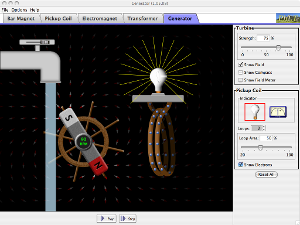
Here is the set of simulations for our EM Induction computer lab. Or, you can click here to go to the PhET site.